
Why We Don't Start Your Weight Loss With Running
How we train for weight loss at BOXLAB, step by step.

Most weight-loss plans start the same way: run more, sweat more, push harder. We start somewhere else. Each step below comes in a fixed order, and the order is the point.
The engine comes first
Picture a 40-year-old coming back after a few years away. Day one, a few hard rounds, and his heart rate is already near the top. Five minutes later, he is done. That is not a willpower problem. His engine is simply not ready for that pace yet.
Your cardiovascular fitness is your engine. It sets how much work you can do before you tire, and the work you do is what burns the calories. A stronger engine means longer sessions, more work in every session, and faster recovery between them. That is why we build the engine first, and we build it in the right heart-rate zones.
Your endurance zones
Every zone starts from your maximum heart rate. We estimate it the way sports science labs do, with the formula 208 minus 0.7 times your age, which came out of a 2001 study in the Journal of the American College of Cardiology and has held up since. At 40, that is about 180 beats per minute. Here is what the zones look like at that age.
90 to 108 bpm
Easy, light effort. Where every session starts and ends.
108 to 126 bpm
Your aerobic base. Most early sessions live here.
126 to 153 bpm
Added step by step as your base builds.
153 to 180 bpm
Kept out of the programme after a break.
These numbers are a starting point. Individual values vary, so your zones are set and checked for you in the club. Endurance athletes spend most of their training, around three quarters or more, at low intensity, because that is what builds the engine. So most of your early training stays in green, with yellow added as you adapt.
What changes in the green zone
Same effort, red zone
The heart works near its limit. You tire fast and stop early.
Same effort, yellow zone
The heart pumps more blood with every beat, so it needs fewer beats for the same work.
We watch this happen in the club every month. A member starts in week one, and three rounds on the pads push him straight into red. Six to eight weeks later, same rounds, same pace, and he finishes in yellow with breath to spare. Nothing about the workout changed. His heart did.
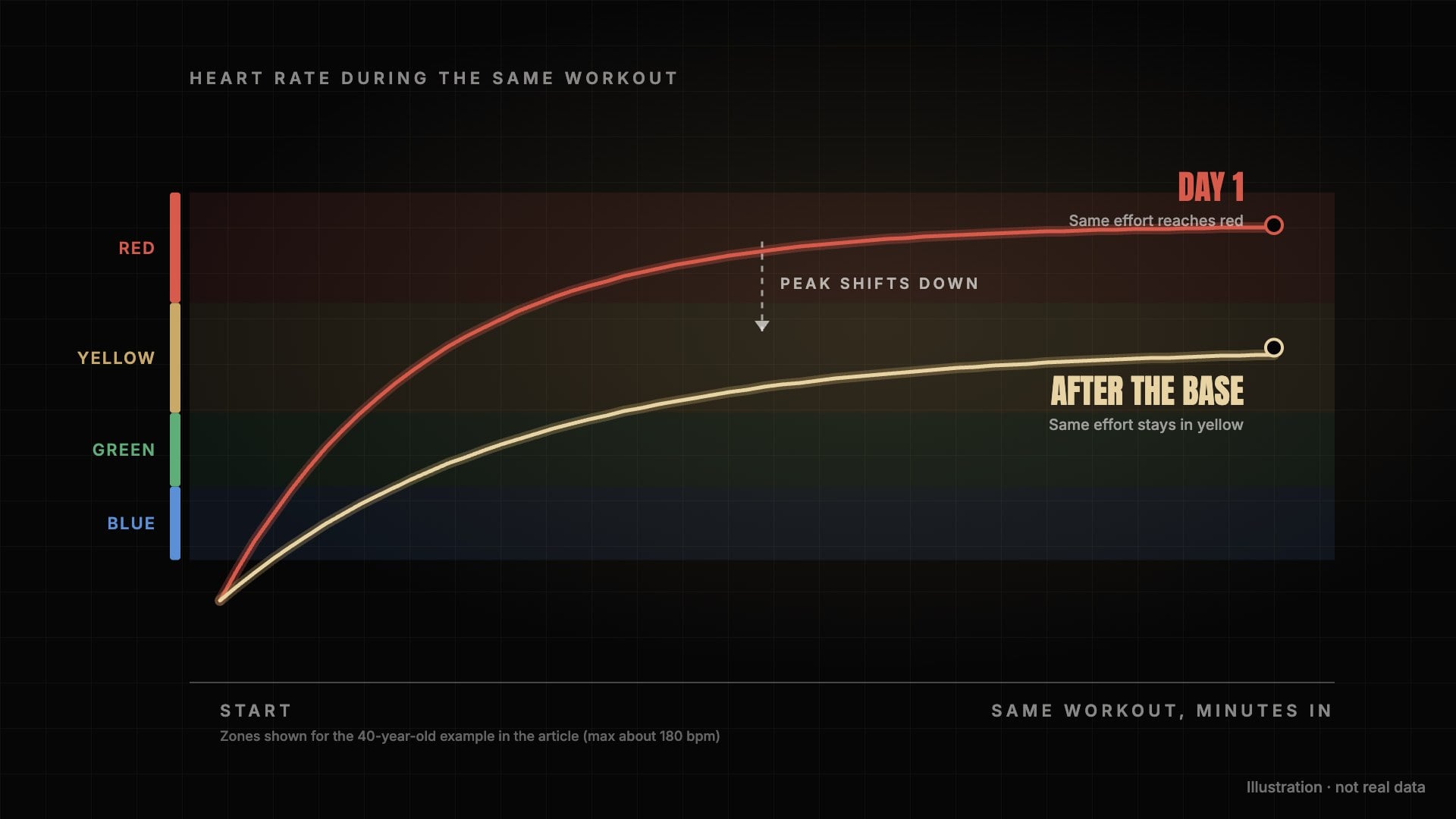
The research says the same. In the HERITAGE Family Study, one of the largest training studies ever run, more than 600 inactive adults trained for 20 weeks, and their heart rate at the same workload fell by about 11 beats per minute. That is the base doing its job. A lower heart rate for the same effort means more work before you tire, and more work is what drives weight loss.
Build the engine first.
Then add everything else.
Low impact before running
When you carry extra weight, every step lands harder. Over thousands of steps, that is a lot of load on your knees, hips and lower back.
The force through your legs with every step, measured on lab force plates.
Two to three times your body weight, landing after landing.
No running, no jumping. Heart rate still up.
So we do not start with running or the treadmill. We use classic boxing instead. It is a basic skill anyone can learn, it keeps the impact low, and it raises your heart rate and burns calories while you learn it.
Strength where it protects you
Braced and steady
A strong trunk keeps your lower back steady under load.
Take the load
Strong glutes take load off your knees and lower back.
Both are built before impact or heavier loads come in. This is the foundation everything else stands on.
Every session has a structure
Warm-up
Prepares your joints and raises your heart rate gradually.
Skill
Boxing technique, so you move well before you move fast.
Conditioning
Time in the right heart-rate zone for your current level.
Strength
Trunk, glutes and full-body work, matched to your stage.
Every drill is chosen for you, not copied from a template.
The programme moves as you do
Build the base
Low impact, steady zones, trunk and glutes first.
Add the next layer
Footwork, skipping, short runs, intervals and heavier strength work.
Nothing is added before your body is ready, and nothing stays the same once you have outgrown it. Weight loss works alongside nutrition and consistency. This is the training side of it, and the order is what makes it last.
Your first step
Every BOXLAB weight-loss programme starts with your tests in the club, so your zones and your starting point are yours, not a chart's. If you would like to see how your programme would be built, book a 15-minute Programme Discussion with a coach. Request a call back
- 01Why We Don't Start Your Weight Loss With RunningYou are here
- 02Why Cardiovascular Fitness Is Weight LossSoon