
Force Has a Direction
Why the strong can be slow, and what changes between the first step and top speed.

Force without direction is noise.
Train the angle, not only the load.
In 2018 I wrote that to go faster, you need more force. A few lines below it I wrote power line from ankle to shoulder and moved on. Seven years of coaching and training myself have taught me that the second line matters more. It is about direction.
Two athletes, same strength
Put two athletes on a start line. Same squat, same body weight, same intent. One leaves faster.
The faster athlete pushes the ground backward, so the ground sends him forward. The slower one pushes mostly down, and a large share of his force lifts him instead of moving him. The ground does not care how strong you are. It returns what you send it, in the direction you send it.
Researchers who have measured sprinters step by step found the same thing. The athletes who accelerate best are not always the ones producing the most total force. They are the ones who keep more of it pointing forward as speed rises.
The line from ankle to shoulder
When the foot is on the ground during acceleration, the body should form one straight line from the ankle, through the hip, to the shoulder. That line is the direction of the push. Hold it at a forward lean and the force goes into the track. Break it at the hip, or stand up early, and the same force goes down.
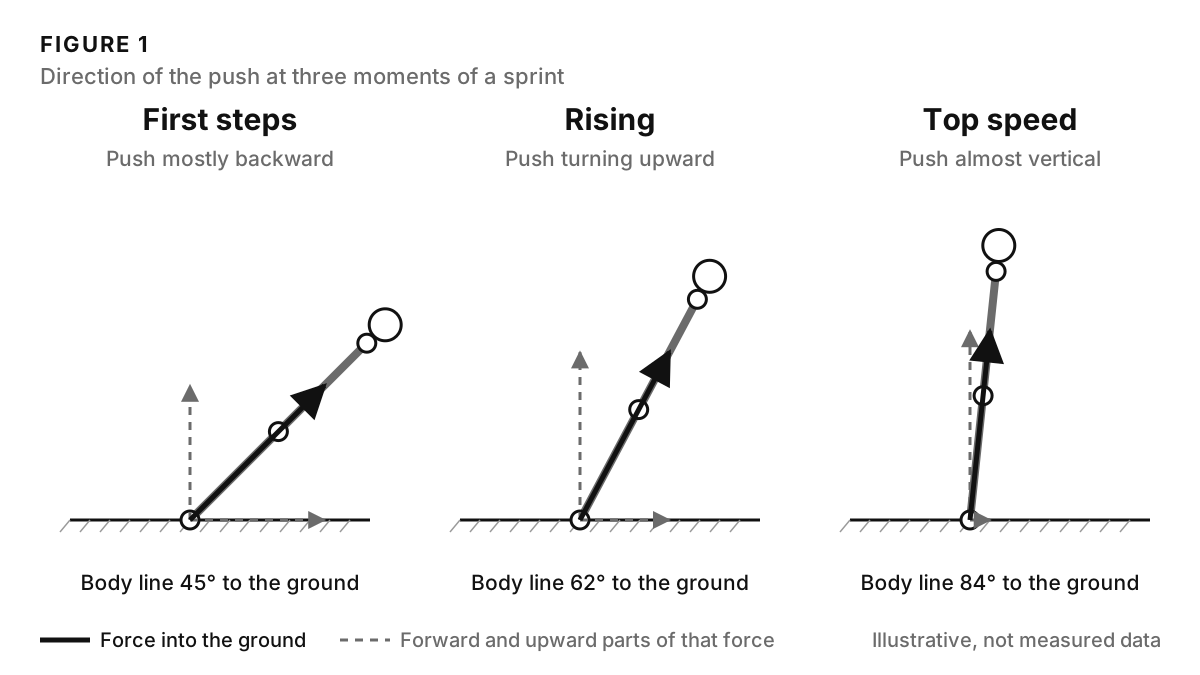
This is why I look at the first step before I look at the first ten metres. The angle you leave at is the angle you push at. Fix it there and the rest of the acceleration inherits it.
The 45 degree lean does not last
In that same 2018 piece I wrote that you cannot run 100 metres with a 45 degree forward lean. That sentence is the whole idea of direction changing with speed.
As speed builds the body rises, ground contact gets shorter, and the push turns vertical. At top speed the fastest runners are the ones who hit the ground hardest and shortest, almost straight down. They are no longer gaining speed. They are holding it, and holding it means fighting gravity, not the track.
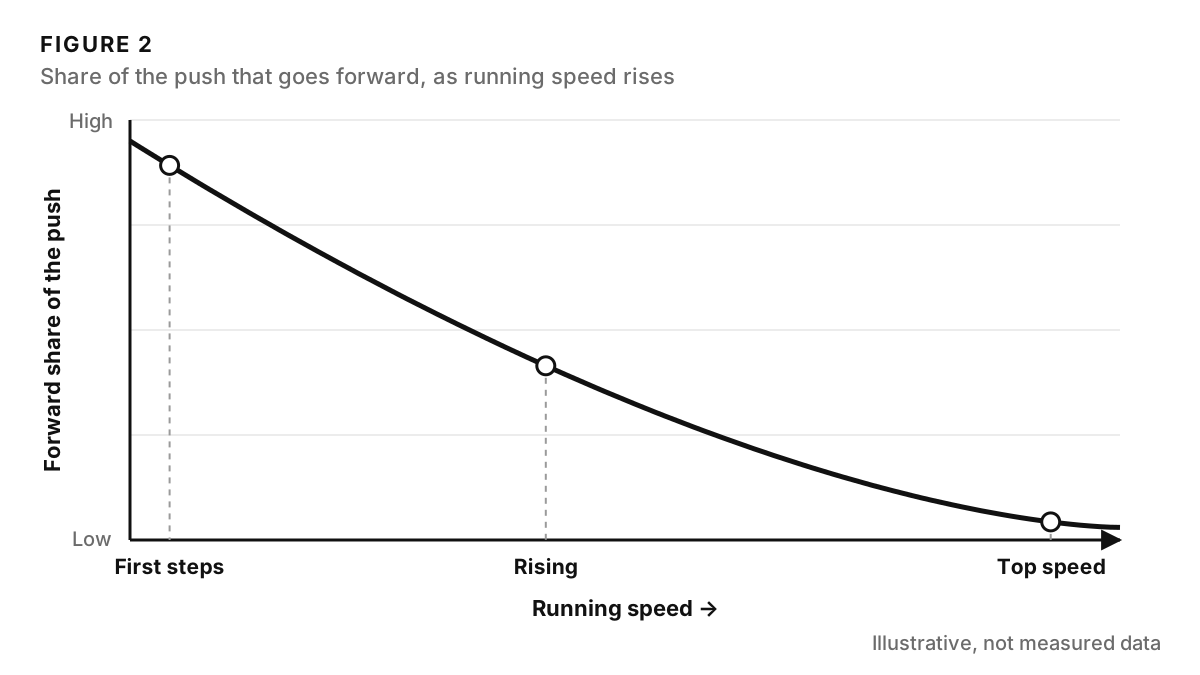
So a good start and a good top speed are two different qualities. A strong, heavy athlete often starts well and fades. A light, springy athlete often starts slowly and flies late. Neither is wrong. They are built for different directions of force.
What I look for in the first three steps
When I watch someone accelerate I am not counting steps, and I am not looking at the arms first. Four questions tell me most of what I need.
Where does the foot land?
Behind the hip, or in front of it.
How does the body rise?
Step by step, or standing up in one hurry.
What is the push doing?
Pushing the ground away, or stepping over it.
Is the line straight?
One line from ankle to shoulder, or broken at the hip.
Most of the time the strength is already there. The direction is what is missing.
Don't skip the strength
None of this means lifting less. A weak athlete with perfect angles is a well organised slow athlete. Build the force in the gym, then teach it where to go: heavy pushes at a forward angle for the start, stiff and fast ground contacts for top speed. The gym supports both. It decides neither on its own.
Build the force, then point it.
- 01Force Has a DirectionYou are here
- 02Max Strength Before PowerSoon